"A man filled with the love of God is not content with blessing his family alone, but ranges through the whole world, anxious to bless the whole human race." Joseph Smith
Showing posts with label NGO. Show all posts

Monday, February 1, 2016

SHARING WARMTH AS WELL AS A HANDSHAKE


After the devastating earthquake that rocked Nepal in April of 2015, thousands of people, particularly in the mountain villages, were left without shelter. Their stone homes which had protected them from the cold now lay in piles of rubble at their feet. With little resources to rebuild a secure home, many are still living in temporary metal and bamboo shelters like this one.


Several families were living together in this shelter.  It is made with corrugated sheet metal.  And they live not far from Mount Everest in the Himalayan Mountains.  What is it like to live inside a metal shelter in the middle of winter in the Himalayan mountains?  I cannot even imagine.  

Under the direction of our Area Presidency, and in partnership with the government of Nepal, LDS Charities ordered 10,000 wool blend blankets to distribute to the villages most affected by the earthquake. Our amazing couples in Nepal, Elder and Sister Oliphant and Elder and Sister Weaver, worked hard to make all the arrangements.  Together with the Area Office we got the blankets ordered from a factory in China (there were no wool blankets available for purchase in Nepal and we can't get anything across the border from India), shipped by truck down to Lhasa, Tibet and then to the Nepal border, and across into Nepal. Thank you to Ryan Lee from the Area Office for these photos.  He flew to the Chinese manufacturing company several times to ensure that our blankets were being made as ordered.

Our blankets are bundled up in bales and are ready for loading and shipping.


Loading 500 bales onto the trucks.


Ready for the trip to Lhasa, Tibet


At Lhasa, they had to unload the bales from the big trucks and re-load them onto smaller trucks so they could make it through the Himalayan Mountains.


Then they made their way through the Friendship Highway - seen below.  This dangerous narrow stretch of road is subject to avalanches, mudslides, robbers and tumbles down the side of the mountain.  We prayed for our blankets!
Courtesy of flikr.com/Steve Hicks


Gratefully, they safely made it, and distribution of the 10,000 blankets was able to be made.  Thank you to Elder and Sister Oliphant for these photos. In the below photo, the bales of blankets are stacked and ready for distribution to this particular village.  You can see the earthquake damage in the building behind the blankets.


Just what we ordered - yay!  The LDSC logo was stitched in the corner of each one.

This man was all smiles for his blanket.  Blankets were handed out to individuals selected by the local village and district government to ensure that only those most needy received them.  Recipient families received one blanket each, regardless of the size of their family.


This man is named Talibas Thresha.  He only had a couple of teeth, but he was very happy to get the blanket.  Here he is walking home after he got one at the distribution.


This is Hari Gurung.  He is 53 years old and from the Chap area of Nuwakot District. 

He said, "We are feeling cold.  Lots of people come and only give us a handshake and say 'Hi'.  You bring us a blanket." 

We asked if the people were happy with the blankets.  He said, "Just look at all the people smiling."
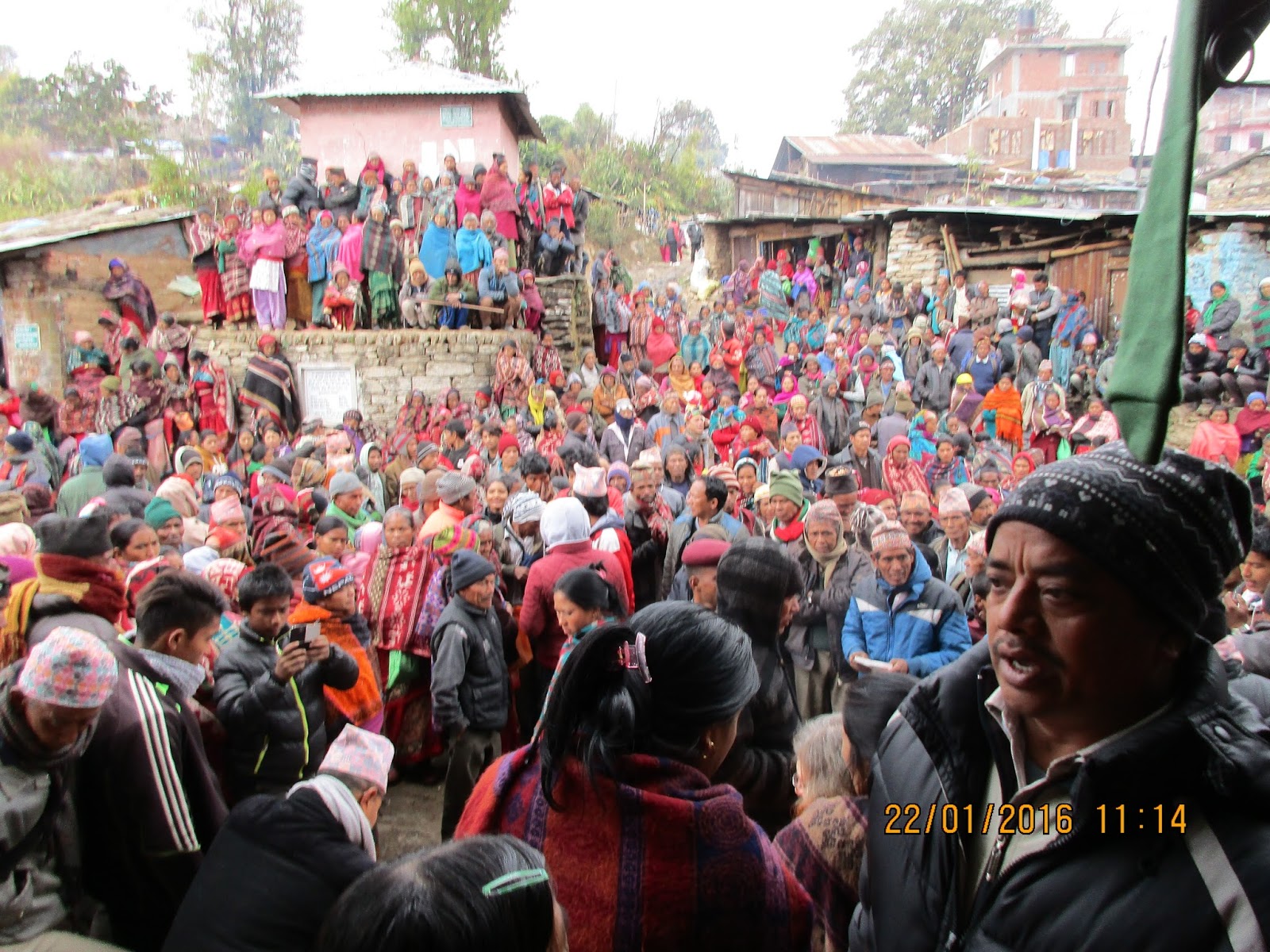


This family has received their blanket and will begin their walk back to their village.  Some travel for several hours to come to the distribution site.  Their villages are often so remote that vehicles cannot reach them.  Some have to cross suspension footbridges to reach the supplies.


In this photo you can see one of the suspension footbridges in the background. The villagers are receiving blankets, tarps and rice.


Supplies loaded on backs, the villagers begin their long hike back to their homes, sometimes several hours away.


10,000 wool blankets. 10,000 warmer homes. Not to mention the tons of other supplies of food and emergency items that have been distributed to those suffering from the earthquake last year. 10,000 blessings.

Thank you to everyone for making this possible.

"And the King shall answer and say unto them, Verily I say unto you, Inasmuch as ye have done it unto one of the least of these my brethren, ye have done it unto me."  (Matt. 25:40)


"This is Manil Toka (the little girl) with Dipu Tamal holding her.  
They had made the hike from the village just to see us."


Friday, August 14, 2015

The Dili Tais Market

Tais is a traditional cloth made exclusively by women from Timor-Leste.  Intricate designs and colors combine together reflecting the dynamics of a people who for generations have clung to culture to bind them together. Skills carefully passed down from one generation to another preserve the knowledge that is unique and distinct to the people of Timor-Leste.

Each municipality in Timor-Leste produces Tais with their own woven pattern with unique colors and patterns. If you knew the patterns well enough, you could identify where in Timor-Leste your textile item came from.  

                                           Welcome to the Dili Tais Market!


Down this little alley are family-run shops full of Tais products, everything from bookmarks and purses to table runners and bedspreads.


The Tais Market is one of the key tourist stops in Dili.  Problem is, there aren't many tourists.....


Women weave the cloth with cotton thread traditionally dyed with tree roots, bark, flowers and other natural items that give the unique colors to the fabric. Today some of the dyes used are no longer from natural substances, but red is still the favorite color, being one of the national colors 
for longevity and courage.


This woman used a spinner to form the cotton threads, and here is rolling the cotton thread into a ball for dying and weaving.


These women show the traditional method used for making the Tais woven designs.


Over the years, this little area where the market now stands has been burned and destroyed multiple times by occupations forces.  In 2008, USAID began providing assistance to help vendors have a secure location for the setting up of stalls to sell their goods. Today babies feed in mothers arms, children grow up under feet, and boys play along the street - and life goes on in the little Tais Market.


Waiting for customers....


Elder Coffey made a new friend.  The mother is wearing a sarong - typical of the traditional skirts worn by many women.  Sometimes these sarongs are also made out of Tais fabric.


Table runners with the traditional colors. Red, yellow and  black are the colors of the country flag. I especially liked this one because it has the classic Timor-Leste crocodile image on it.  


Tais has been one of the ways that the Timorese people have held together culturally through the years of wars, destruction and genocide. Capturing the determined spirit of the people, Fernando Sylvan, a Timorese poet, writes:

Culture are the memories of a people who refuse to die!  
Action is the history of a people who refuse to die!
Did you hear me?
Did you hear me well?
Life is the freedom of a people who refuse to die!
Independence is the craving of a people who refuse to die!
Did you hear me?
Did you hear me well?
Justice is the endowment of a people who refuse to die!
Struggle is the finding of a people who refuse to die!
Did you hear me?
Did you hear me well?


Wednesday, May 27, 2015

"Our Home Is Gone, But We Are Happy"

We met Yak on our trip to Nepal.  He is a member of the Kathmandu branch. Yak Adhikari (no relation to Bishnu Adhikari) was born in a remote village in Nepal. His father was disabled and his mother was not able to support him any longer.  When he was about 8 years old, his mother dropped him off in the bigger city of Kathmandu for him to seek his fortune and his survival.  Yak did what he could to survive.  He took in odd jobs and lived on the street as one of the many street kids.  Sometimes he wouldn’t get paid for the work he did, or would get beaten. He only had a 4thgrade education before he had to drop out of school entirely.

Eventually he got a job as a rickshaw driver.  One of his customers was a wealthy Danish business man who took a liking to Yak.  The man was also a Latter-day Saint. He took Yak under his wing, hired him for translation services and other jobs, and stayed in touch with him in between business trips.  In the process, he also taught Yak the Gospel, and eventually Yak joined the Church.  Later, he was privileged to serve a mission to New Delhi, India, all because of the kindness of his Danish benefactor. 

Following his mission, he wanted to continue his schooling.  Again, his Danish friend helped with the expenses.  Yak started back to school with 8 and 9 year olds, picking up where he left off from the 4th grade, in his ambitious goal to someday become a doctor.  He studied and studied.  In 1 ½ years he made it to the 10thgrade.  Today he is 24 years old and is continuing his studies through the generosity of his Danish friend.

Yak also takes care of his two younger siblings.  His 14 year old sister, Ramila, and 12 year old brother, Janak, are pictured above with Yak in the center.  He also is raising his 3 year old nephew.  They live in a one room windowless hostel while they go to school.  He loves his mother, who still lives in the village, and is very close to her. He stays in touch with her as he works hard to raise this little sibling-family with an education.

When the 7.8 earthquake hit on April 25th, they were at church with the rest of the Kathmandu Branch. They ran outside the building like everyone else and stayed for a while with the saints, until people began to filter off to their individual homes or to the villages to see how their families were.  Yak and his sibling-family returned to the nearly empty, damaged, hostel.  No one wanted to stay indoors. The aftershocks kept going, unnerving everyone. 

Members of the branch huddle outside the Church immediately following the first earthquake.

Someone then approached him and said, “I know you.”  Yak replied, “I don’t think I know who you are.”  But the man said, “I know you.  I think you need a tarp,” and handed him a large tarp. 

That night, while so many others were without any kind of shelter, he and his sibling-family were under cover from the elements because of the kindness of someone he didn’t know.

When he later visited his mother in the village, he saw the devastation and all the ruined homes.  He took his tarp and gave it away to those in greater need than he.

Back in Kathmandu, the Church began to receive relief supplies and gave him a tarp since he no longer had one.  He went right back to the village and shared his tarp with his family.

Elder Funk of the Asia Area Presidency visited Nepal recently to meet with the saints and strengthen and encourage them.  Elder Funk spoke to Yak and asked how he was.  “My family is safe,” he said.  “Our home is gone, but we are happy.”

Members of the Kathmandu Branch, several weeks after the earthquakes.

Amazing Partners Helping with Nepal's Earthquake Recovery


Nepal suffered another set back when, following the April 25th 7.8 earthquake that leveled thousands of homes, a 7.3 earthquake struck on May 12th, further collapsing already weakened homes. People who had begun returning to a sense of normalcy were again forced to sleep outside under tarps, or in the open, for safety.  Between the two quakes, over 8,600 lives have been lost and hundreds of thousands have been displaced.

LDS Charities works with local non-government organizations (NGO's) in Nepal in our humanitarian efforts. One of these NGO's is with Bishnu Adhikari, famous for his spot in Meet the Mormons. Bishnu heads the NGO called CHOICE-Nepal.  Bishnu and his family are absolutely amazing, faithful people who are so exemplary and so well respected throughout Nepal. Bishnu is a member of the Kathmandu Branch, the former Branch President, and a loving and caring family man.  We are so blessed to be able to work with him.  

Bishnu Adhikari chats with Elder Coffey in Kathmandu, Nepal, November 2014


Elder Coffey, Bishnu Adhikari, and Sister Coffey in Nepal, November 2014


Our second amazing NGO partner is with Rakesh Hamal, head of the Nepal Rehabilitation Society for the Disabled (NRSD), which helps disabled people in Nepal become self reliant. He also heads Safa Sanaulo Nepal, which addresses the medical needs of Nepal through clean water and other health issues.
  
Rakesh points out NRSD projects throughout Nepal
  
One of Rakesh's projects, JAWS, helps visually impaired people, such as this man at the computer keyboard, learn computer skills to become employable.  Rakesh is on the right.
This week Rakesh made a visit to Hong Kong to meet with us and the Area Presidency.  Elder and Sister Valentine, our Nepal humanitarian couple, are also here in Hong Kong until they are able to get back into Nepal.  

Elder and Sister Coffey, Elder and Sister Valentine, and Rakesh Hamal


Rakesh with the Area humanitarian team and the Area Presidency


Both Bishnu and Rakesh and their NGO's have been hard at work getting relief supplies out to the hardest hit areas from the earthquake. Relief efforts will take decades, but we are grateful we can help in at least a small way.

A home in a village where Rakesh has helped distribute emergency supplies.  You can see the crumbled rock homes in the background.
Many people's homes, even in Kathmandu, were damaged or totally destroyed. Many people are sleeping outside under tarps, waiting for the aftershocks to settle down and waiting to rebuild their homes. Rakesh and his wife have two young children.  Although their modest stone home was one of the ones not damaged, their children have been traumatized by the earthquakes and are too afraid to sleep inside their homes. So at night, Rakesh and his family sleep outside under tarps, like so many others, just to support their little children. Sometimes when it rains they will sleep in the car. Eventually they will move back inside, but only when their children feel safe to do so.

These are the kinds of partners we have in Nepal. Genuine, compassionate, trustworthy, honest.  May they be blessed as they continue to bless the lives of others throughout Nepal.

Courtesy of Flikr.com/International Organization of Migration - People living under tarps or tents.

Courtesy of Flikr.com/ International Labor Organization